







Understanding Mood Disorders: A Q&A with Jane Stallman '25 on Research in the Cognition and Emotion Lab


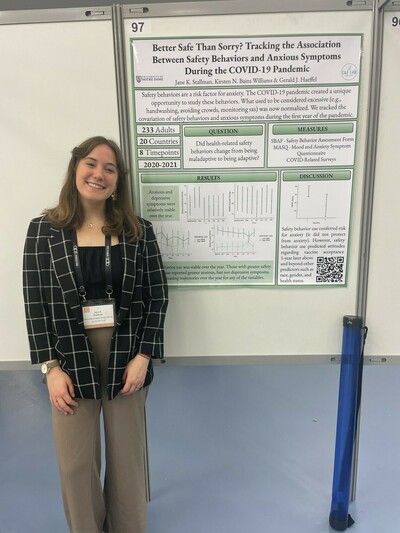
Like most students, Jane Stallman '25 learned about the scientific method in school. In her time as a psychology major at Notre Dame, the Nashville, TN native has embraced the opportunity to apply it. Stallman is an undergraduate researcher in the Cognition and Emotion Lab on campus and here she talks about answering big questions, research funding at Notre Dame, and why she loves what she's learning.
What I do:
At Notre Dame, I have worked in the Cognition and Emotion Lab directed by Dr. Gerald Haeffel since the beginning of my sophomore year. The lab focuses on training undergraduates who are interested in pursuing or working in areas adjacent to clinical psychology. The lab’s main research focus is cognitive theories of mood disorders, mainly depression and anxiety. We hope to help answer the question: Why is it that the same negative life event can happen to two people, and one person may develop a mood disorder while the other does not?
Throughout the years, I have been able to work on three different projects. My sophomore year, I started with a study analyzing data collected by the lab during the first year of the COVID pandemic.
I was able to present the findings of this project at the International Convention for Psychological Science (ICPS) in Brussels, Belgium, and have a first-authored paper published in the journal Social and Personality Psychology Compass.
My junior year, I worked on a paper analyzing the differences and similarities between two different psychological theories, one called "hopelessness theory" and one called "primal world beliefs." That paper is currently submitted for consideration for publication as well!
Now, I am starting my third project in the lab, which will be my psychology senior thesis. As a data science minor, I have been super interested in the developments being made in the world of AI and large language modeling, specifically GPT.
My senior thesis will be analyzing GPT’s ability to predict future rises in depressive symptoms when given people’s written responses to a measure of cognitive risk for depression.
This research is important because being able to predict rises in depression from someone’s writing could potentially lead to the development of cheaper and more accessible risk or diagnostic assessments, which would be especially helpful in areas where seeing a mental health professional in person for an assessment can be location- or cost-prohibitive.
How I got started:
My freshman year, I was actually planning to be a computer science major. However, I took Dr. Haeffels University Seminar during my first semester, and it was by far my favorite class. I ended up signing up for his Intro to Clinical Psychology class the next semester and meeting with him to discuss his lab to see if I would be interested and a good fit.
I ended up joining the lab after that, and also ultimately declaring my major as psychology. I still really enjoy computing, so I am a data science minor and enjoy those classes greatly as well. I have been in the lab, and a psychology major, ever since!
What I’ve learned so far:
If you asked me what research was in high school, I definitely would have described someone in a lab coat pipetting for hours on end. So, I never really pictured it as something I would be involved in. However, my view of research has completely changed during my time in college.
There are opportunities for research in literally every field, and I am happy to have found a great opportunity within my field! I have also learned so much about what the research process looks like. You grow up learning about the scientific method in every science class ever, but it is so cool to actually be a part of it, from conceptualizing a study and conducting a literature review, to writing up the results, presenting at a conference, and publishing the findings.
How my research funding works:
Throughout my time in the lab, I have received funding from two different departments on campus, the Flatley Center for Undergraduate Scholarly Engagement (CUSE) and the Institute for Scholarship in the Liberal Arts (ISLA).
I applied for and received a grant for Sorin Scholars from CUSE my sophomore year that allowed me to attend the ICPS conference, covering all costs associated with traveling to and from the conference and during my time there.
For my senior thesis work, I applied for and received a Comprehensive Summer Grant from ISLA, which is covering my living expenses for the summer in addition to research costs. Any other costs associated with doing research have been covered by my lab.
What I love about doing research at Notre Dame:
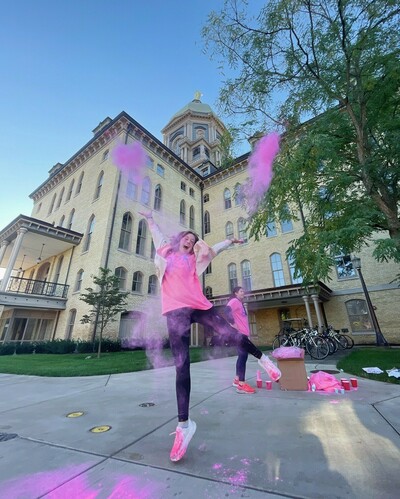
I absolutely love that I get to be a part of studying things that no one else has ever studied before. Notre Dame, and my lab, definitely do a great job of making sure that the undergraduates are able to get very involved in all the steps of the research process, so that you leave Notre Dame prepared for graduate school, or with analytical skills that will be super helpful in any career path.
Advice for students interested in doing research at Notre Dame:
Talk to all kinds of people! Professors and other students that do research are almost always more than happy to talk about the research that they do, and to discuss your fit for joining their lab or provide you with an application if they currently have space to take on another undergraduate student researcher.
Also, if you are interested in pursuing a project on your own and have a faculty member willing to oversee the project, you can get funding from departments on campus, like ISLA, to take on that project yourself.
In general, it never hurts to reach out and learn more if you find a lab or professor doing research that interests you! Also, reach out early! Don’t assume that you have to wait until you are an upperclassman or starting a senior thesis to do research. There are lots of opportunities for first- and second-year students to get involved as well.
Learn More
- Can Arts & Letters Majors Do Research at Notre Dame? Absolutely! Two Students Share their Stories
- Dig into Undergraduate Research! 6 Students Share Their Research and How They Got Started
- ND Journey: Matt Kianpour '24 Conducts Research, Studies Abroad
Originally published by at admissions.nd.edu on July 03, 2024.
Latest Research
- ‘A special challenge’: German studies scholar wins National Humanities Center fellowship for research on medieval womenFor CJ Jones, the joy of research is not the answers but the journey. And the next step on that journey is a fellowship with the National Humanities Center. …
- Notre Dame Lead Innovation Team partners with local WIC program to identify, prevent lead poisoning in childrenB.A.B.E. store “shoppers” now have something new to help their families: free lead screening kits offered by the University of Notre Dame’s Lead Innovation Team.
- Notre Dame Welcomes Ninth Cohort of Warrior-Scholars for Transformative Academic JourneyNOTRE DAME, IN – The University of Notre Dame recently concluded its ninth successful Warrior-Scholar Project (WSP) boot camp, hosting 34 dedicated Warrior-Scholars from June 21st to 28th. This intensive, week-long academic residency provided transitioning service members and veterans…
- Entrepreneurship and Empowerment in South Africa study abroad program celebrates 25 yearsThis year, the Entrepreneurship and Empowerment in South Africa (EESA) program marked its 25th year of operation. EESA is a six-week summer study abroad program that enables students to help historically…
- Vatican honors Martin and Carmel Naughton with papal awardCarmel…
- Brain tumor growth patterns may help inform patient care managementAssistant Professor Meenal Datta (University of Notre Dame/Wes Evard) A team of researchers from the University of Notre Dame, Harvard Medical School/Massachusetts General Hospital, and Boston University has developed a technique for measuring a brain tumor’s mechanical force and a new model to estimate how much brain tissue a patient has lost.


