




Lieberman’s rapid screening card for antibiotics wins 2025 Trinity Challenge


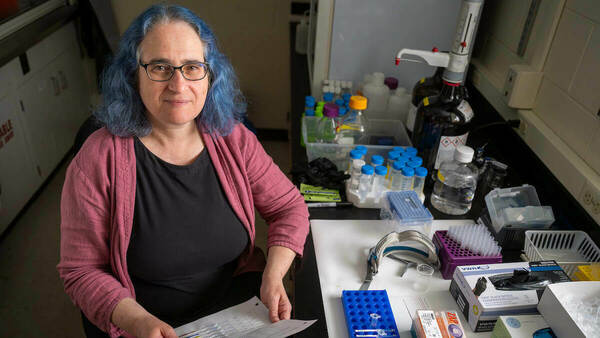
A research team headed by Marya Lieberman, Nancy Dee Professor of Cancer Research in the Department of Chemistry and Biochemistry at the University of Notre Dame, was named joint grand prize winner of the 2025 Trinity Challenge, a global innovation competition dedicated to tackling the growing problem of community access to antibiotics around the world.
Lieberman’s Paper Analytical Device Project (PAD) is a low-cost, rapid screening card that, when paired with a mobile app, allows medical professionals to test antibiotics and determine within seven minutes whether they are substandard or falsified. PADs are designed to be scalable, and used in parts of the world where access to reliable antibiotics remains a major public health challenge.
The other grand prize winning team, led by Yemisi Ogundare, project director for Jhpiego Nigeria, developed Com-WATCH, an integrated, data-driven technology for tracking stock control and identifying substandard and falsified antibiotics in Nigerian communities. The two winners of the Trinity Challenge were selected from 171 applications from 51 countries, and the prize includes an award of £500,000 (approximately 672,000 U.S. dollars) over two years to each winner.
Lieberman’s PADs do not require the use of additional chemicals, solvents, instruments or electricity, and have been proven effective throughout Africa. They identify medications that do not contain the correct chemicals, or the correct amount of chemicals, and they interface with stock control technologies, Lieberman said. The award will allow Lieberman to expand the PAD program to Cameroon, Ethiopia, Kenya, Malawi and Namibia.
“I’m honored and really grateful,” she said. “Antimicrobial resistance threatens us all, because bacteria don’t pay attention to borders.”

The award will allow Lieberman’s lab to test the antibiotics that are most important in treating bacterial infections in community settings in low- and middle-income countries. Ensuring that sick people and animals get good quality antibiotics will protect patients and slow down development of “superbugs,” which are strains of bacteria that become resistant to antibiotics.
“We are interested in building tools that will let people test antibiotics in their own communities,” Lieberman said. “By sharing these rest results across multiple sites, we can increase the impact.”
People in low- and middle-income countries lack access to common antibiotics. Of the 7.75 million who die of bacterial sepsis each year, almost 3 million have infections that could be treated with common oral antibiotics like penicillin and amoxicillin. The lack of access has caused increased antimicrobial resistance, with deaths in both humans and animals.
This year marks the third time the Trinity Challenge has been held. The first, in 2021, was based on pandemic preparedness, and the 2024 challenge was focused on antimicrobial resistance.
“Our new winners from our third challenge have applied innovative thinking to this complex problem in global health, and I applaud their creativity and dedication,” said Professor Dame Sally Davies, executive chair of the Trinity Challenge as well as the UK Special Envoy on antimicrobial resistance, in a news release. “They show that everyone can make a difference and be part of the solution to the antibiotic emergency.
“Their plans to harness the power of new and existing technology and local level data to successfully detect substandard and falsified antibiotics or track stock control within a country will fill knowledge gaps and inform decision-makers.”
This is the second award for Lieberman’s PAD project in 2025. She also received the Gustavus John Esselen Award for Chemistry in the Public Interest in February.
“At Notre Dame, we are driven by a commitment to serve communities and promote human dignity. Professor Lieberman’s PAD project exemplifies those ideals by ensuring access to safe, effective medicines, and this award will allow her to expand its impact to more people who need it most,” said Steve Corcelli, interim William K. Warren Foundation Dean of the Notre Dame College of Science.
Latest ND NewsWire
- Researchers deconstruct chikungunya outbreaks to improve prediction and vaccine developmentThe symptoms come on quickly — acute fever, followed by debilitating joint pain that can last for months. Though rarely fatal, the chikungunya virus, a mosquito-borne illness, can be particularly severe for high-risk individuals, including newborns and older adults. While the virus is common…
- Eck Institute investigator to strengthen postpartum care for Indiana mothersYenupini Joyce Adams, associate professor of the practice and maternal health lead for the Eck Institute for Global Health at the University of Notre Dame, is partnering with Beacon Health System to pilot a new, first-of-its-kind postpartum care model in the South Bend-Elkhart community.
- Gen. Martin Dempsey to speak at Notre Dame Forum event on ‘Hope, Global Stability and the Role of the United States’Gen. Martin Dempsey, the retired 18th chairman of the Joint Chiefs of Staff, will join University President Rev. Robert A. Dowd, C.S.C., for a fireside chat at 4 p.m. Friday (Oct. 10), as part of the 2025-26 Notre Dame Forum. The discussion, titled “Hope, Global Stability and the Role of the United States,” is part of the exploration of this year’s Notre Dame Forum theme, “Cultivating Hope.” It will take place in Rooms 215/216 of McKenna Hall and will also be livestreamed. The event is free and open to the public.
- University of Notre Dame joins the Global Coalition of Ukrainian StudiesThe University of Notre Dame has joined the Global Coalition of Ukrainian Studies after signing a memorandum of cooperation, formalized Sept. 24, at the Ukrainian Institute of America in New York City. Notre Dame joined four other American institutions that were also publicly welcomed to the coalition at this event: Arizona State University, Columbia University, Manor College and the Shevchenko Scientific Society.
- One year later, Inauguration Build a ‘dream come true’ for Habitat familiesOne year later, work on Inauguration Build 2024 is complete, offering shelter and so much more to five local families.
- Alumni Association and YoungND honor 2025 Domer DozenThe Notre Dame Alumni Association announced its 2025 Domer Dozen cohort, honoring 12 graduates ages 32 and younger for excellence in their contributions in learning, service, faith and work — the core pillars of the association’s mission.