







Notre Dame literacy research can improve learning outcomes and fight global poverty


A new study by a team of University of Notre Dame researchers makes a significant contribution to understanding the factors that influence how young elementary school students respond to reading interventions in fragile and low-income contexts.
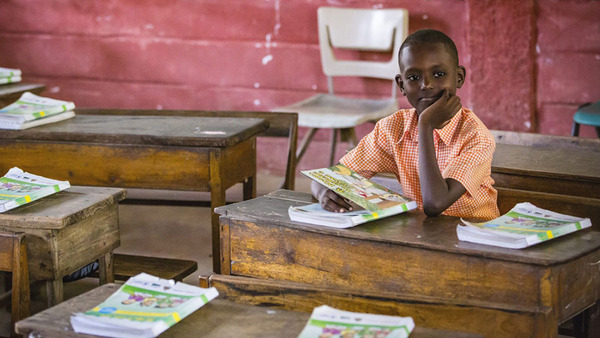
The study, published in the Comparative Education Review, evaluated an early-grade literacy intervention in Catholic schools in Haiti. The study has important implications for addressing educational inequities and improving learning outcomes to create opportunity and lift millions of children globally out of poverty.
“This research brings greater attention to questions of educational equity in the acquisition of foundational skills,” said lead author TJ D’Agostino, assistant professor of the practice with the Pulte Institute for Global Development, part of the University of Notre Dame’s Keough School of Global Affairs. “Which populations are being well served, which can we serve better, and how do we accomplish that? These findings can help guide future research and policy to expand literacy rates in low- and middle-income countries.”
Past research has shown that achieving reading comprehension by the end of second grade is crucial to progressing in school, which impacts future life opportunities, D’Agostino said. Some studies suggest achieving universal literacy could reduce global poverty by more than 10 percent.
Schools participating in the study received specialized teacher training as well as a curriculum in Haitian Creole and French that included a collated library. The curriculum included time for teachers to read aloud to students as well as time for students to read on their own. A group of coaches regularly visited participating schools to share best practices and evaluate what worked.
The study identified several factors that affected outcomes, including:
-
Instructional time (which suffered in some schools because of high rates of student and teacher absenteeism)
-
Curriculum uptake (whether teachers adhered to the new curriculum or instead mixed and matched it with more familiar resources)
-
School leadership (which was crucial to protecting time for learning, encouraging teacher buy-in to the program and providing extra support for students)
Researchers found that rural schools faced particular challenges, D’Agostino said, since they were more remote, received fewer coaching visits, tended to serve more marginalized populations and often experienced higher rates of student absenteeism.
D’Agostino worked with fellow co-authors Danice Brown Guzmán and Paul Perrin of the Keough School’s Pulte Institute; Anasthasie Liberiste-Osirus, a training and technical assistance consultant who previously worked with Notre Dame’s Global Center for the Development of the Whole Child (GC-DWC), part of the University’s Institute for Educational Initiatives; and Kate Schuenke-Lucien of the GC-DWC.
The literacy intervention and research to evaluate its impact was supported by the GC-DWC Haiti in collaboration with Catholic Relief Services, the Catholic Church in Haiti, USAID, the W.K. Kellogg Foundation and an anonymous foundation. The program served more than 100,000 first- through third-grade students in nearly 350 schools between 2016 and 2020.
Ultimately, the study helped the Notre Dame team identify questions for future research, the co-authors said, and can inform future literacy interventions by organizations such as USAID, which is the largest bilateral donor of basic education assistance and works in more than 50 countries.
“Improving literacy skills in the school environment is an important part of a broader, deeper set of outcomes needed to address poverty,” Schuenke-Lucien said, noting that researchers sought to engage students holistically using home and church resources as well.
D’Agostino agreed. “It is deeply rewarding to contribute to programs that help people in marginalized communities develop life-changing skills,” he said, “and it is energizing to be a part of Notre Dame’s larger work to fight poverty.”
Originally published by Josh Stowe at keough.nd.edu on Feb. 21.
Contact: Tracy DeStazio, associate director of media relations, 574-631-9958 or tdestazi@nd.edu
Latest International
- Prioritizing prenatal care may decrease low birth weight outcomes in The Gambia, Notre Dame research findsA new study co-authored by University of Notre Dame researchers highlights the importance of prenatal care for improving the health of mothers and newborns, providing evidence that can inform policy.
- Navigating the waters of peace: Researchers address challenges, opportunities in implementation of Colombia's Peace AgreementNearly half of the commitments outlined in Colombia's historic peace accord face significant challenges and may not happen in time unless policymakers make several key interventions, warns a new report from Notre Dame's Peace Accords Matrix. The report offers a blueprint to salvage an accord that has lagged behind its implementation deadlines, putting its legacy at risk. It highlights timely fixes that can strengthen the agreement.
- Partial peace deals may facilitate comprehensive accords, offering roadmap for policymakers, practitionersPartial peace agreements — deals that address targeted issues on the way to larger comprehensive accords — could provide a blueprint for peacebuilding policymakers and practitioners, according to new University of Notre Dame research.
- CANCELED: University to host Cardinal Pedro Barreto of Peru and Cardinal Peter Turkson of Ghana as part of Notre Dame ForumAs part of the 2024-25 Notre Dame Forum, Cardinal Pedro Ricardo Barreto Jimeno, S.J., of Peru and Cardinal Peter Kodwo Appiah Turkson of Ghana will visit the University of Notre Dame to participate in a conversation with President Rev. Robert A. Dowd, C.S.C., at 11:30 a.m. April 25 in the Smith Ballroom of the Morris Inn. The conversation is open to the public and will also be livestreamed for both Spanish-speaking and English-speaking audiences.
- ‘Who the messenger is matters’: Cultural leaders can positively influence population growthFertility rates across the world have been steadily dropping since 1950. Pinpointing the reasons is at the heart of Lakshmi Iyer's work as a professor of economics and global affairs. Her research exemplifies the kind of population-level research that Notre Dame Population Analytics (ND Pop), a new research initiative at the University, seeks to foster.
- Lessons from Venezuela’s democratic collapse: How opposition movements can defy autocratic leadersLaura Gamboa, a political scientist at the University of Notre Dame, explores how opposition movements navigate authoritarian regimes in a study of Venezuela's political transformation. The research analyzes the effectiveness of various strategies, including electoral participation, in the face of eroding democratic norms.


