







Using forest resources strengthens food security, study finds


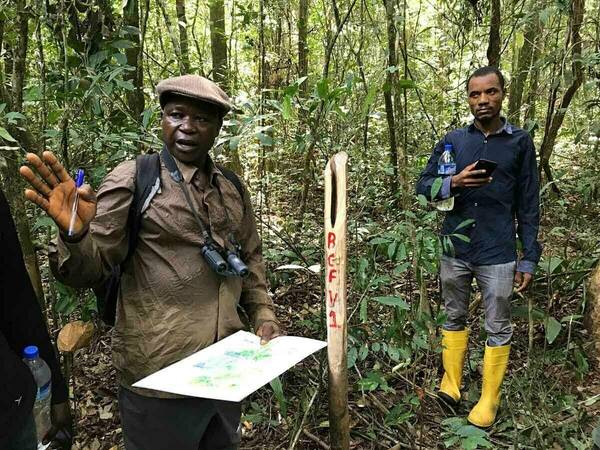
Forests can reduce hunger in rural households while also capturing carbon and advancing sustainability goals for low- and middle-income countries, according to new research by University of Notre Dame experts.
Households in Liberia that participated in forest-based activities — including collecting and processing timber, hunting bushmeat or gathering edible plants — reduced their food scarcity by 84 percent, according to a study published in the journal Food Security. The research was conducted by Daniel C. Miller, associate professor of environmental policy at Notre Dame’s Keough School of Global Affairs, and co-author Festus Amadu, a former Notre Dame postdoctoral researcher who is now assistant professor of climate policy at Florida Gulf Coast University.
“Previous research has shown that forests benefit people, but now we have evidence on a national scale,” Miller said. “Forests are a vital source of food security for forest-adjacent households in Liberia, the most forested country in West Africa.”
Miller and Amadu analyzed data from a 2019 survey by the Liberian government and the World Bank. Miller, a former World Bank senior forestry specialist, helped design the survey, which collected data from nearly 3,000 households living near forests across all 15 counties in Liberia. The researchers found that when households reported engaging in forest-based activities, they also reported food insecurity for almost three fewer months out of the year.
Food insecurity is severe in many countries in sub-Saharan Africa, including Liberia, where most rural households do not have access to enough food to meet their daily calorie intake requirements for the whole year, Miller said. Causes of this food insecurity include extreme weather events, political instability, and poor agricultural productivity caused by natural resource depletion. Existing research shows that forests may be more resilient to some of these stresses, making them increasingly vital for reducing food insecurity in countries such as Liberia, where forests comprise 69 percent of its land area.
“Forests do a lot of things for us as human beings, and yet their manifold contributions are not systematically studied and documented,” Miller said. “While forests will never substitute for agriculture on any large scale, they can serve as an important food source, particularly in lean times.”
Miller said the study’s methodology — using forest-specific data acquired on a national scale — could be applied to other forest-rich, economically poor countries in West Africa and elsewhere to further understand how forests can mitigate food insecurity.
“Forests can and should be considered by national governments in other countries not only for their climate and environmental benefits, but for their potential to support human development and well-being,” he said.
The research was supported by the Forests & Livelihoods: Assessment, Research and Engagement (FLARE) network, which Miller leads, with funding from Notre Dame Research, the Notre Dame Environmental Change Initiative and the Keough School.
In future studies, Miller and Amadu will examine how forest governance, particularly at the community level, affects how people living near forests can benefit from them. Miller also said the study’s findings have important policy implications and could be used by policymakers focused on forest management and conservation.
“The benefits that forests create for the citizens of a country are yet another reason why forests are worth managing well and conserving,” Miller said. “When you have empirical evidence at the national level, it becomes relevant not only in scholarship but also for the policy realm.”
Originally published by Renée LaReau at keough.nd.edu on July 22.
Contact: Tracy DeStazio, associate director of media relations, 574-631-9958 or tdestazi@nd.edu
Latest International
- Prioritizing prenatal care may decrease low birth weight outcomes in The Gambia, Notre Dame research findsA new study co-authored by University of Notre Dame researchers highlights the importance of prenatal care for improving the health of mothers and newborns, providing evidence that can inform policy.
- Navigating the waters of peace: Researchers address challenges, opportunities in implementation of Colombia's Peace AgreementNearly half of the commitments outlined in Colombia's historic peace accord face significant challenges and may not happen in time unless policymakers make several key interventions, warns a new report from Notre Dame's Peace Accords Matrix. The report offers a blueprint to salvage an accord that has lagged behind its implementation deadlines, putting its legacy at risk. It highlights timely fixes that can strengthen the agreement.
- Partial peace deals may facilitate comprehensive accords, offering roadmap for policymakers, practitionersPartial peace agreements — deals that address targeted issues on the way to larger comprehensive accords — could provide a blueprint for peacebuilding policymakers and practitioners, according to new University of Notre Dame research.
- CANCELED: University to host Cardinal Pedro Barreto of Peru and Cardinal Peter Turkson of Ghana as part of Notre Dame ForumAs part of the 2024-25 Notre Dame Forum, Cardinal Pedro Ricardo Barreto Jimeno, S.J., of Peru and Cardinal Peter Kodwo Appiah Turkson of Ghana will visit the University of Notre Dame to participate in a conversation with President Rev. Robert A. Dowd, C.S.C., at 11:30 a.m. April 25 in the Smith Ballroom of the Morris Inn. The conversation is open to the public and will also be livestreamed for both Spanish-speaking and English-speaking audiences.
- ‘Who the messenger is matters’: Cultural leaders can positively influence population growthFertility rates across the world have been steadily dropping since 1950. Pinpointing the reasons is at the heart of Lakshmi Iyer's work as a professor of economics and global affairs. Her research exemplifies the kind of population-level research that Notre Dame Population Analytics (ND Pop), a new research initiative at the University, seeks to foster.
- Lessons from Venezuela’s democratic collapse: How opposition movements can defy autocratic leadersLaura Gamboa, a political scientist at the University of Notre Dame, explores how opposition movements navigate authoritarian regimes in a study of Venezuela's political transformation. The research analyzes the effectiveness of various strategies, including electoral participation, in the face of eroding democratic norms.


